
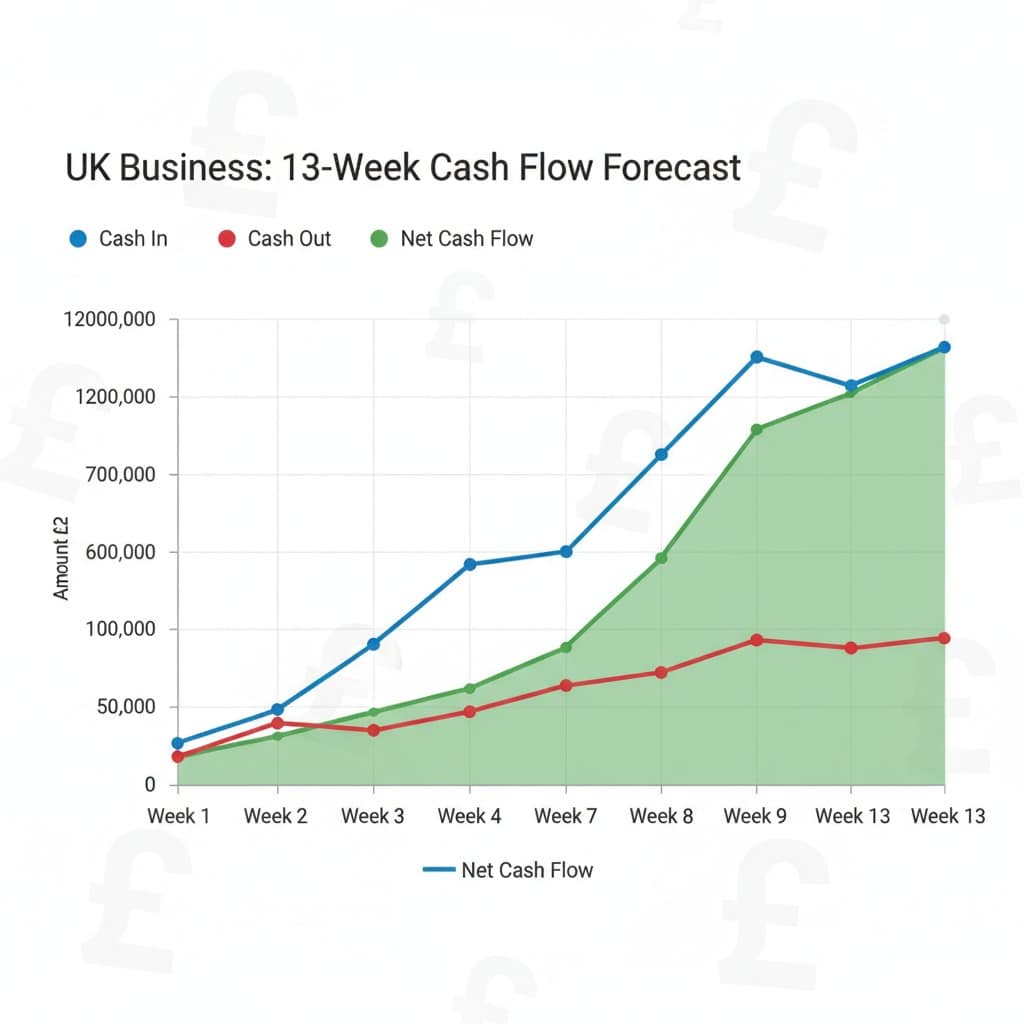
The “Cash Flow is King” Reality
We have all heard the cliché that “Cash Flow is King”.
While it might sound cheesy, in the 2026 economic climate and our highly regulatory culture, it is more relevant than ever.
A well-thought-out plan is essential for operating a professional, sustainable business.
While profit is the goal, cash is the fuel.
A 13-week window is the industry standard because it captures a full VAT quarter—preventing the “tax season panic” by making upcoming non-negotiable outflows visible well in advance.
Why a 13-Week View is the “Gold Standard” for Your Business
By the time you’ve been in business for thirty or forty years, you develop a “gut feeling” for your bank balance.
But in today’s UK economy, gut feeling isn’t enough to satisfy lenders, and it isn’t enough to protect your legacy.
The 13-week rolling forecast is simply a three-month look ahead.
It’s the industry standard because it aligns perfectly with a VAT quarter.
It moves the conversation from “What happened last month?” to “What is coming at us in the next 90 days?”
The Core Benefits: No Surprises, No Panic
1. An Eight-Week “Early Warning” System
If you have a cash shortfall coming, you need time to fix it.
Finding out on a Friday that you can’t meet Monday’s payroll is a crisis.
Finding out eight weeks in advance is just an administrative task.
A 13 – week window acts as an early warning system.
It gives you the “vital breathing room” – at least eight weeks of lead time – to address predicted shortfalls.
It gives you the time, to chase late payers, negotiate with suppliers, or arrange a short-term facility with the bank.
2. Eliminating Surprise
Vat, Paye, and National Insurance are non-negotiable.
They shouldn’t be surprises. By looking 13 weeks ahead, these “big hits” stay visible on your dashboard at all times.
You stop seeing that money as “available cash” and start seeing it as “reserved funds.”
3. Proactive, Not Reactive
Instead of checking your bank balance to see if you can afford a new hire or a piece of equipment, you check your forecast.
It allows you to model “what-if” scenarios. “If we lease that new van in Week 6, what does our bank balance look like in Week 12?” It replaces guesswork with data.
4. Credibility with the Bank
If you ever need to borrow money or renew a facility, a professional 13-week forecast is your best weapon.
It proves to a lender that you are in total control of the numbers. It moves you from a “high-risk” category to a “managed-risk” category.
Alignment: It ensures your projections are realistic and accounts for the regulatory environment, such as health and safety or building regulations that impact your industry
.
The Ropho Method: A Better Way to Look at Numbers
In my PDF portfolio, I introduce the Ropho method (Rolling-Projected-Historical-Outcome). This ensures your financial plan is not a “one-time event” but an evolving tool. It involves:
- Rolling: We update it every week. As one week finishes, we add a new “Week 13” at the end. It never stops.
- Projected: We put in our best estimates for the future based on the work we have booked and the bills we know are coming.
- Historical: Using past financial performance as a guide for future accuracy. We look at what actually happened last week. Did we spend more than we thought? Did a client pay late?
- Outcome: This is the bottom line. It’s the projected bank balance at the end of the 13 weeks. Highlighting how balance sheets and income affect your actual cash equivalents.
Why I Recommend a Template Over “Automated” Software
Software like Sage and Xero is excellent for keeping your books for the tax man.
But for steering the ship, I often recommend a dedicated template.
Why?
Because your Business is Unique to You!
Because manually reviewing the numbers once a week forces you to engage with the reality of the business.
It’s the difference between looking at a map and actually driving the car.
It keeps you sharp, keeps you informed, and – most importantly – it keeps you in control.
Final Thought for the Director
You’ve worked too hard to let a “timing gap” or a late-paying client cause you unnecessary stress.
A 13-week forecast isn’t just an accounting tool; it’s a peace-of-mind tool.
It ensures that the business you’ve built stays as solid as the day you started it.
“A 15-minute review of your 13-week forecast can save months of financial stress.
I’ve written a more in-depth analysis of why cash flow management is so critical for UK directors in 2026, including a breakdown of my custom ROPHO template.
It’s available in my newsletter as part of this 8-week series. Join the conversation here.”
Leave a Reply